Friday, 12 May 2017

Nanny Barbara - Children and their Prams

Prams have almost disappeared in 2017, but here are two amazing, very deep, rather ugly, looking 'perambulators' from the 1930s that Barbara would have pushed her charges around in. They are probably coach built, the wheels are quite large, and notice they have mudguards fitted, all making for a more comfortable ride. You have to admit the children look warm, safe and comfortable don't they?

I believe it is a little boy in the coat, love his boots, and can't make my mind up whether that is a bandage on his leg.  


Barbara's Two "Cheeky Chappies in the 1930s

This pram doesn't have such big wheels, but they look as if they could have inner tubes that again could give a very comfortable ride.  That is an amazing very smart outdoor uniform that Barbara is wearing. 


Tuesday, 9 May 2017

Nanny Barbara - Graduation


At the time this photograph was taken, Barbara Stafford would have been living through the effects of the Great Depression of 1929-32.  A time when the United Kingdom was still far from having recovered from the effects of the First World War. There was an overall climate of unrest with unemployment rising to 70%.  

Barbara will have experienced first hand the 1926 National Strike called by the Trades Union Congress in support of the miners, when approximately one million were locked out of their mines after a dispute with owners who wanted them to work longer hours for less pay. All this was compounded by the 1929 Wall Street Crash leading to the devaluation of the pound - thus creating even more unemployment and poverty which was endemic in the North East.  Barbara will have read in newspapers about hunger marches, and in 1936 the North East's own Jarrow March took place. Perhaps it was all this that spurred Barbara on to leave home and train to be a Nanny. 

I can only make a guess at the year, circa 1929 when this photograph was taken by an unknown "T D Arnold Sheffield", or where the Nanny Training Course took place, the only clue is that it was taken in or around the Sheffield area.  

It is interesting that the uniforms are so like a nurses. The lady seated left in black is wearing a uniform like that of hospital matron, and the lady to her right, seated, is wearing a white coat with a nurses headdress.  Everyone is very serious.  Barbara is first left


A Qualified Nanny 

Saturday, 6 May 2017

Alfred Stafford WW1 - Battlefield Tour - Menin Gate Ypres

The final photograph from Alfred's Battlefield Tour is the huge awe-inspiring Menin Gate.  Here we see one of his colleagues, in contemplative mood, standing to the side of the Gate. Even Alfred's small sepia photograph managed to capture how colossal it is - just look how small the people are in comparison to this structure.


1929 Menin Gate


The Menin Gate Memorial to the Missing is dedicated to the British Commonwealth soldiers who were killed in the Ypres Salient, whose graves are unknown.  It is located at the eastern exit of the town and marks the starting point for one of the main roads out of the town that led Allied soldiers to the front line.


Designed by Sir Reginald Blomfield and was unveiled on 24th July 1927.


From 11th November 1929 (every night whatever the weather) at 8:00pm a moving ceremony takes place under the Menin Gate, Ypres. The Last Post Ceremony has become part of the daily life for the people of the town.


Menin Gate Today - a similar shot to Alfred's 


Its large Hall of Memory contains 54,395 names on stone panels of Commonwealth soldiers who died in the Salient, but,whose bodies have never been identified or found.  

On completion of the memorial it was discovered to be too small to contain all the names as originally planned, therefore, an arbitrary cut-off point of the 15th August 1917 was chosen, leaving the names of 34,984 British soldiers, who had 'no known grave', to be inscribed on the wall of the Tyne Cot Memorial to the Missing instead. The Menin Gate Memorial does not list the names of soldiers of New Zealand and Newfoundland, instead they are honoured on separate memorials.   


Menin Gate Hall of Memory


Tynecot Wall and Graves


This photograph shows Alfred's colleagues walking through the town of Ypres towards the Menin Gate.


1929 Walking Through the Town of Ypres towards the Menin Gate


The town today seen through the Arch


The Lion and Inscription atop of the Menin Gate Arch


Perhaps a fitting way to end Alfred's Battlefield Tour, is this well known extract from Robert Laurence Binyon's (1869-1943) famous war poems "For The Fallen"  published in the Times Newspaper on 21st September 1914 


"They shall not grow old as we are left grow old:
Age shall not weary them, nor the years condemn.
At the going down of the sun and in the morning
We will remember them."


Friday, 5 May 2017

Alfred Stafford WW1 - Battlefield Tour - Tynecot


Alfred and his colleagues visited Tyne Cot Cemetery - the largest Commonwealth war graves cemetery in the world,(located just south-west of Passchendaele Belgium). This photograph was taken of The Cross of Sacrifice. It was built on top of a German pill box in the centre of the cemetery, purportedly at the suggestion of King George V who visited the cemetery in 1922 as it neared completion. 

Alfred's photograph shows the quiet respect of those looking for the graves of loved ones.  The women are in dark clothing and the gentlemen have their hats in their hands. So moving and terribly sad.

1929 Tyne Cot Cemetery Cross of Sacrifice


Tyne Cot CWGC (Commonweath War Graves Commission) Memorial to the Missing was designed by Sir Herbert Baker and was unveiled on the 20th June 1920. There are 11,953 burials. On the wall at the back of the cemetery are 34,927 names of men who died from August 1917 to the end of the war, who have no known graves. 


The Cross of Sacrifice today


This is a recent ariel view of Tyne Cot, its size must be overwhelming to visitors. Here lies the remains of thousands of men brought in from isolated graves and small cemeteries when the war ended, however, it was also a battlefield burial ground. The headstones immediately behind the Great Cross, in less organised rows are the original burial plots. 


Thursday, 4 May 2017

Alfred Stafford WW1 - Battlefield Tour - Vimy Ridge


The back of this (poor quality) photograph states "Memorial to Canadians Vimmy Ridge." The photograph, just about shows stonework, and a lot of debris lying around with a rail line in front.  In 1929 this Memorial was under construction.     

1929 Canadian Memorial Vimy Ridge

The Memorial was designed by the Canadian monument sculptor and designer Walter Seymour Allward, CMg RCA (1876-1955).

This is a recent view of the completed Memorial, its size is colossal.  It overlooks the Douai Plain from the highest point of Vimy Ridge.  Commemorating over 11,000 Canadian soldiers who were posted as 'missing presumed dead' in France and as a tribute to all Canadians who served their country in battle.

It lies about eight kilometers northeast of Arras. Situated in a 91 hectare memorial park, stocked with great masses of Canadian trees and shrubs to resemble the wood and forests of Canada.  Eleven thousand tonnes of concrete and masonry were required for the base of the Memorial, and 5,500 tonnes of 'trau stone' were brought from Yugoslavia for the pylons and the sculptured figures. Construction of the colossal work began in 1925, and 11 years later on July 26 1936 King Edward VIII unveiled the monument.  


 Canadian Memorial Vimy Ridge Today


I am sure there will have been reports and pictures published in British newspapers in 1936, allowing Alfred and his colleagues to see this magnificent monument in its finished state?


'Mother Canada' Vimy Ridge Memorial


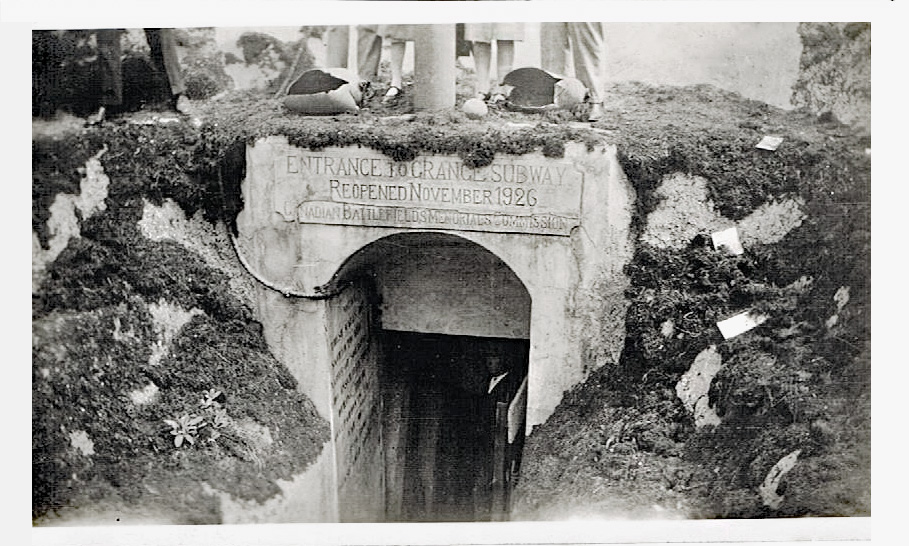
Named Grange Subway because of a Grange that stood on this spot.  Intersecting tunnels were built and used by the allies in fighting at Vimy Ridge.  Even though it was cold, damp and dark it was better than the trenches.


Wednesday, 3 May 2017

Alfred Stafford WW1 - Battlefield Tour - 50th Northumbrian Division


In their tour visiting battlefield and memorials Alfred and his colleagues visited the impressive Memorial to the 50th Northumbrian Division not far from Ypres in the hamlet of Wieltje, Belgium. 


1929 50th Division Northumbrian Memorial


The memorial is a plain white pillar, standing beside a farm on a windswept hillside.


50th Northumbrian Division Memorial today


An addition was made to the memorial to include the Divisions role in the Second World War.


1929 Postcard  from France to Alfred's daughter Eleanor aged 17


Monday, 1 May 2017

Alfred Stafford WW1 1929 - Battlefield Tour - Back in the Trenches


Here we see Alfred with his two comrades, having climbed down into an overgrown trench.  I am sure all of them, even Alfred (who was in his 40s and younger than his companions) would have found it 'tricky' to negotiate. 

If you look carefully to the right, it looks like there is a young man in uniform 'gingerly' climbing down into the trench. What is interesting is that there is a woman standing up-top with two gentlemen, (you can only see her legs and skirt) so it wasn't just army veterans who returned.

It looks as if the weather was hot, as you can see the gentleman in the middle is holding a large handkerchief in his hand.  He has made a little concession to the heat, as he has removed his hat, and was probably using the 'hanky' to mop his forehead. As we have seen on all the photographs he is still carrying his brolly, the quintessential Englishman. 

Also, when I blew the photograph up to restore it a little I realised there was added heart-breaking poignancy to this, in that Alfred is holding a poppy.


Restored 1929 Alfred in overgrown trench with his three comrades